
안녕하세요, 송쌤입니다.
이번 시간에는 but for, without 가정법을 공부해 보겠습니다. 처음 보면 조금 어렵지만 주절만 잘 보면 됩니다.
가벼운 퀴즈로 시작합니다.
 but for, without 퀴즈!
괄호 안에서 알맞은 것을 고르세요.
①But for my wife, I would be an idiot. = If it ( were not for / had not been for ) my wife, …
②Without your help, I ( would fail / would have failed ) yesterday.
③If it had not been for my wife = ( Had it not been / Were it not ) for my wife
정답 보기
① were not for
② would have failed
③ Had it not been
1. 규칙이 있는 if 대용어구
13-12 if 대용어구 (suppose, provided, in case, if only)에서 본 말들은 뜻만 알면 됩니다. 지금부터 볼 네 가지는 시제나 형태에 따로 규칙이 있어서 하나씩 자세히 공부합니다.
- but for, without (이 글)
- unless (13-14 unless 뜻과 용법 총정리)
- It is time (13-15 It is time 가정법 (It’s time you went to bed))
- otherwise (13-16 otherwise 용법 (그렇지 않으면, 그 외에는, 달리))
2. 뜻과 시제
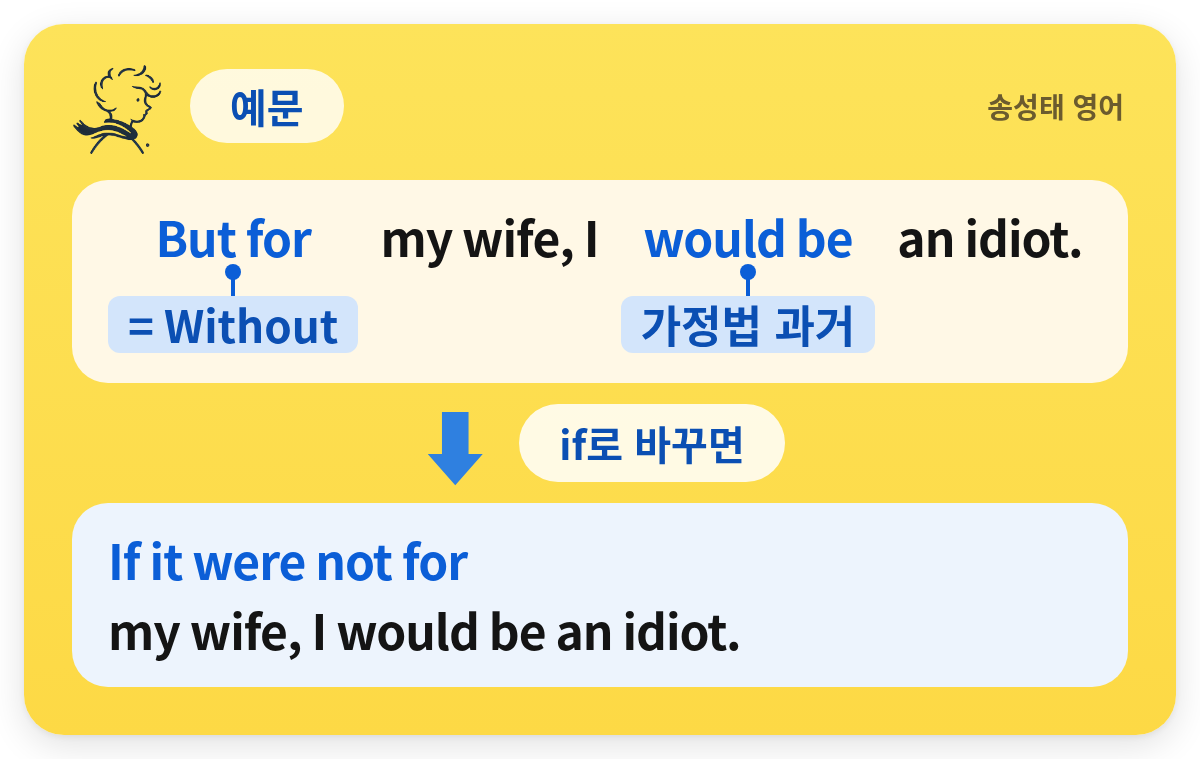
but for와 without은 ‘~이 없다면’, ‘~이 없었다면’이라는 뜻입니다. 그 자체에는 시제가 없어서 주절의 시제를 보고 판단합니다. without은 일상에서도 많이 쓰지만 but for는 주로 글에서 씁니다.
가정법 과거주절 would + 동사원형 → ~이 없다면 = If it were not for
가정법 과거완료주절 would have p.p → ~이 없었다면 = If it had not been for

(1)But for(Without) my wife, I would be an idiot.
(아내가 없다면 나는 바보일 거야)
→ 주절 would be: 가정법 과거
(1-1)If it were not for my wife, I would be an idiot.
(2)But for(Without) my wife, I would have been an idiot.
(아내가 없었다면 나는 바보였을 거야)
→ 주절 would have been: 가정법 과거완료
(2-1)If it had not been for my wife, I would have been an idiot.
→ Quiz ①
3. 시제 고르기
if it were not for와 if it had not been for 가운데 무엇을 쓸지도 주절을 보고 정합니다.
(3)If it ( were not for / had not been for ) your help, I would fail.
(네 도움이 없다면 나는 실패할 거야)
→ 주절 would fail: 가정법 과거
→ Quiz ②
4. if 생략 도치
13-11 if 생략 가정법 (Were, Had, Should가 앞으로)처럼 if를 생략하고 were, had를 주어 앞으로 보낼 수 있습니다. 글에서 자주 봅니다.
(1-2)Were it not for my wife, I would be an idiot.
→ If it were not for
(2-2)Had it not been for my wife, I would have been an idiot.
→ If it had not been for
→ Quiz ③

- if 대용어구 (suppose, provided, in case, if only)
- if 생략 가정법 (Were, Had, Should가 앞으로)
- unless 뜻과 용법 총정리
- It is time 가정법 (It’s time you went to bed)
- otherwise 용법 (그렇지 않으면, 그 외에는, 달리)
update on 2026-11-07 by Song SSam
답글 남기기