안녕하세요, 송쌤입니다.
오늘은 이솝 우화 일곱 편을 원문으로 읽어 보겠습니다. 문장마다 끊어 읽고 영어 순서대로 직역했습니다.
☰ 목차
- 1. 이솝 우화에 대하여
- 2. The Lioness (암사자)
- 3. The Wild Ass and the Lion (들나귀와 사자)
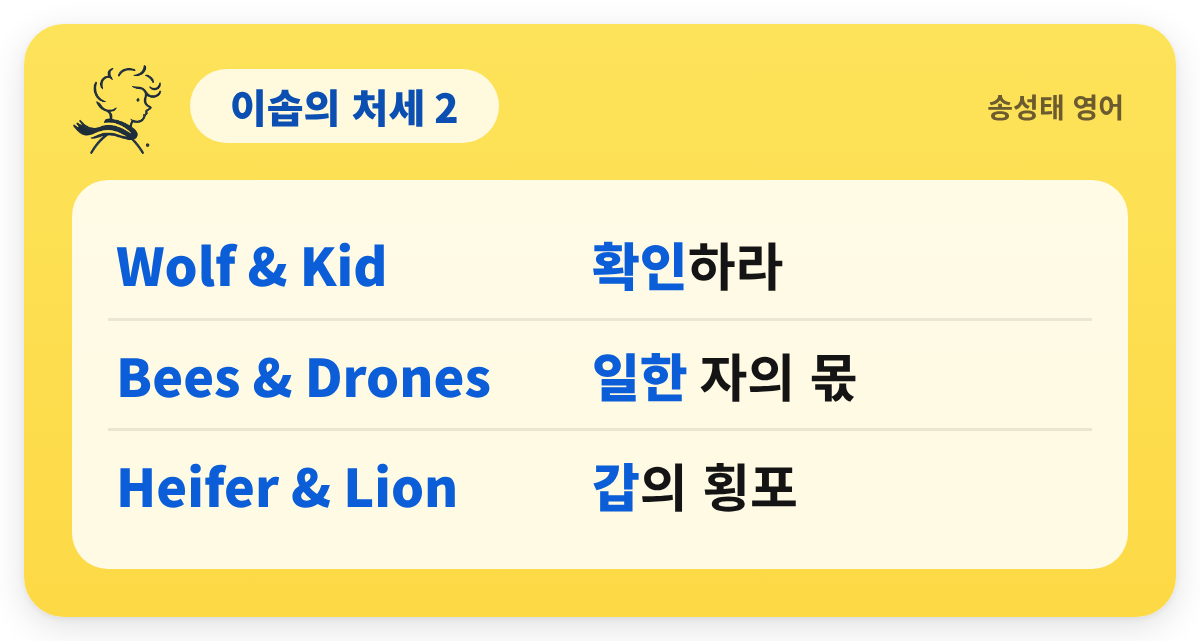
- 4. The Wolf, the Goat and the Kid (늑대와 염소와 새끼 염소)
- 5. The Bees, the Drones, and the Wasp (벌과 수벌과 말벌)
- 6. The Heifer, the Goat, the Sheep and the Lion (암소와 염소와 양과 사자)
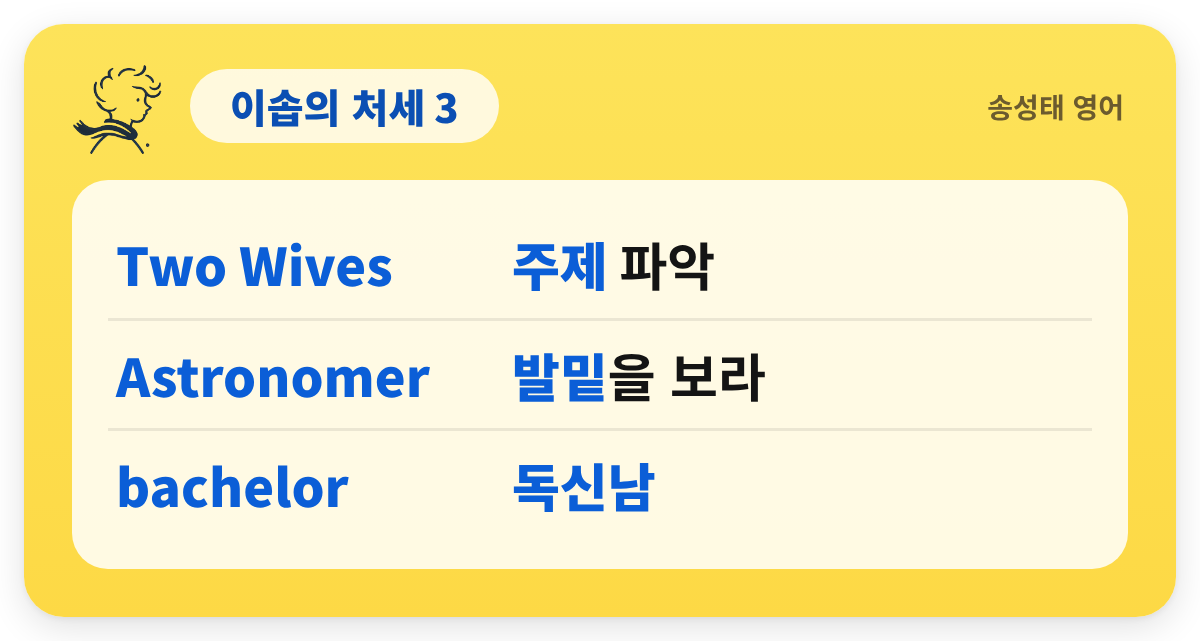
- 7. The Man and His Two Wives (남자와 두 아내)
- 8. The Astronomer (천문학자)
- 9. 정리
가벼운 퀴즈로 시작합니다.
 이솝 우화 퀴즈!
괄호 안에서 알맞은 것을 고르세요.
①unless you willingly resign it은 ( 넘긴다면 / 넘기지 않는다면 )이다.
②The Drones는 ( 수벌 / 일벌 )이다.
③a middle-aged bachelor는 ( 중년의 독신남 / 중년의 이발사 )이다.
정답 보기
① 넘기지 않는다면 — unless = if ~ not
② 수벌 — 일하지 않는 벌
③ 중년의 독신남 — bachelor ≠ barber(이발사)
1. 이솝 우화에 대하여
이솝은 고대 그리스(기원전 6세기 무렵)에 살았던 이야기꾼이었습니다. 원래 노예 신분이었던 그는 이야기 재능을 인정받아 자유민이 되었다고 전해집니다.
이솝의 이야기 스타일은 동물을 의인화한 우화의 형식을 빌려 인간을 풍자하는 것이었습니다. 노예가 사물과 똑같이 취급되던 시기에 주인의 심기를 거스르는 직접적인 말은 위험했기 때문입니다. (나중에 델포이 사람들에게 죽임을 당했다는 이야기가 전해지는 것을 보면 이솝의 판단이 맞았던 것 같습니다.)
어린아이용으로 각색된 이솝 우화에는 「바르게 살자」, 「착하게 살자」 같은 교훈을 주는 이야기가 주로 나옵니다. 그렇지만 원문에는 교훈적인 내용이라기보다는 처세술에 관련된 이야기가 많이 나옵니다.
당연합니다. 노예였던 이솝이 본 세상은 위험한 정글이었습니다. 날씨만큼 변화무쌍한 주인의 감정에 따라 언제든지 매질부터 죽음까지 당할 수 있는 것이 노예였습니다. 그런 이솝에게는 「어떻게 살아갈까」보다 「어떻게 살아남을까」라는 질문이 훨씬 현실적이었습니다.
슬프게도 「어떻게 살아남을까」는 지금도 필요한 덕목입니다. 노예 제도는 없어졌지만 「눈 감으면 코 베어 가는 세상」에서 살고 있으니까요. 그렇다고 너무 우울하게 생각하지 말고 가볍게 한번 읽어 볼까요? 원문은 19세기 영어 번역판입니다.
끊어 읽기가 처음이라면 끊어 읽기(Chunking)란? 긴 영어 문장이 쉬워지는 이유와 영어 끊어 읽기 3원칙 (긴 주어 뒤, 접속사 앞, 전치사 앞)를 먼저 보세요. 이 글의 / 는 의미 덩어리, // 는 긴 주어가 끝나는 자리입니다.
2. The Lioness (암사자)
(1)A controversy prevailed/ among the beasts of the field, as to which of the animals deserved the most credit/ for producing the greatest number of whelps/ at a birth.
(논쟁이 벌어졌다/ 들판의 짐승들 사이에, 어느 동물이 가장 칭찬받아야 하는지를 두고/ 가장 많은 새끼를 낳는 것에 대해/ 한 배에)
(2)They rushed clamorously/ into the presence of the Lioness, and demanded of her/ the settlement of the dispute.
(그들은 떠들썩하게 몰려갔다/ 암사자 앞으로, 그리고 그녀에게 요구했다/ 논쟁을 결판내 달라고)
(3)“And you,” they said, “how many sons have you/ at a birth?”
(「그럼 너는,」 그들이 말했다, 「아들을 몇이나 낳느냐/ 한 배에?」)
(4)The Lioness laughed at them, and said: “Why! I have only one; but that one is altogether a thorough-bred Lion.”
(암사자는 그들을 비웃으며, 말했다: 「뭐라고! 나는 하나뿐이다; 하지만 그 하나는 완벽한 순종 사자다」)
whelp(짐승의) 새끼
at a birth한 배에, 한 번에 낳는
thorough-bred순종의
MEANING : 멀티태스킹보다는 선택과 집중이라는 말입니다.
3. The Wild Ass and the Lion (들나귀와 사자)
(1)A Wild Ass and a Lion entered into an alliance/ that they might capture the beasts of the forest/ with the greater ease.
(들나귀와 사자가 동맹을 맺었다/ 숲의 짐승들을 잡으려고/ 더 쉽게)
(2)The Lion agreed/ to assist the Wild Ass/ with strength, while the Wild Ass gave the Lion the benefit/ of his greater speed.
(사자는 동의했다/ 들나귀를 돕기로/ 힘으로, 반면에 들나귀는 사자에게 이득을 주었다/ 자기의 더 빠른 속도라는)
(3)When they had taken as many beasts/ as their necessities required, the Lion undertook/ to distribute the prey, and for this purpose divided it/ into three shares.
(그들이 짐승을 잡았을 때/ 필요한 만큼, 사자가 맡았다/ 먹이를 나누는 일을, 그리고 이를 위해 그것을 나누었다/ 세 몫으로)
(4)“I will take the first share,” he said, “because I am king; and the second share, as a partner/ with you/ in the chase; and the third share (believe me) will be a source of great evil/ to you, unless you willingly resign it/ to me, and set off/ as fast as you can.”
(「첫째 몫은 내가 갖겠다,」 그가 말했다, 「내가 왕이니까; 그리고 둘째 몫은, 동업자로서/ 너와 함께한/ 사냥의; 그리고 셋째 몫은 (내 말 믿어라) 큰 화근이 될 것이다/ 너에게, 네가 기꺼이 넘기지 않는다면/ 나에게, 그리고 떠나지 않는다면/ 되도록 빨리」)
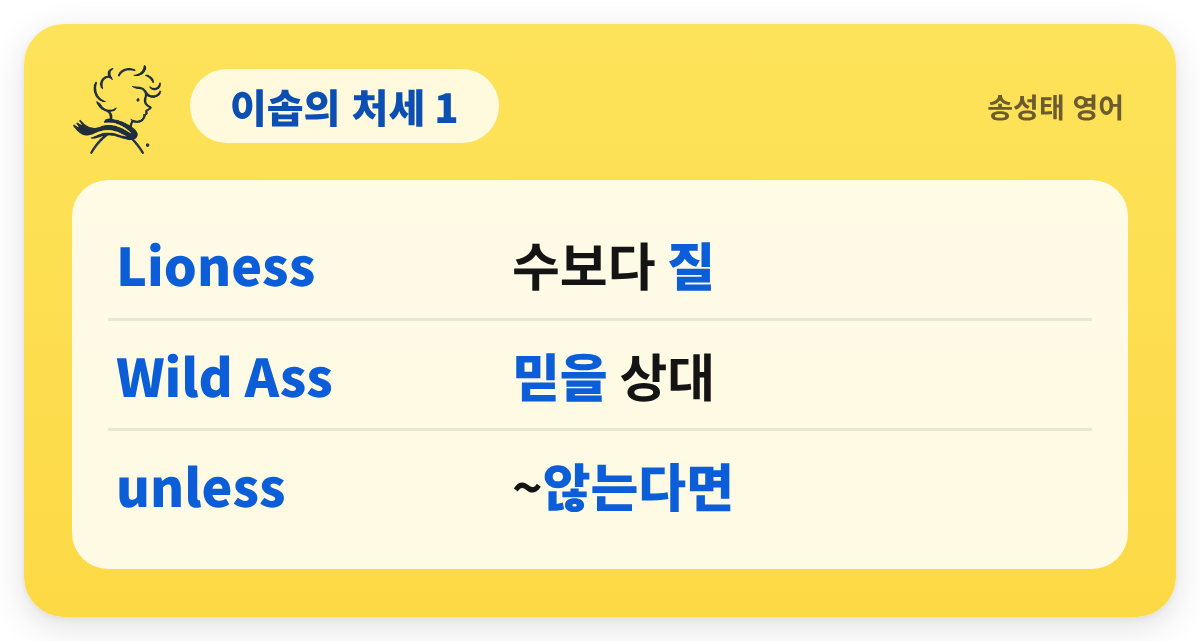
alliance동맹 (enter into an alliance = 동맹을 맺다)
undertake to~하는 일을 맡다
unless~하지 않는다면
resign(권리를) 넘겨주다
→ Quiz ①
MEANING : 믿을 놈을 믿으라는 평범한 진리입니다.
4. The Wolf, the Goat and the Kid (늑대와 염소와 새끼 염소)
(1)As an old Goat was going forth/ to pasture, she carefully latched her door, and bid her kid not to open it/ to any one/ who could not give this pass-word: “Beware of the Wolf and all his race.”
(늙은 염소가 나가면서/ 풀을 뜯으러, 문을 조심스럽게 걸어 잠그고, 새끼에게 문을 열지 말라고 일렀다/ 누구에게도/ 이 암호를 대지 못하는: 「늑대와 그 족속을 조심하라」)
(2)A Wolf happened to be passing, and overheard/ what the old Goat said.
(늑대가 마침 지나가다가, 엿들었다/ 늙은 염소가 한 말을)
(3)When she was gone, he went to the door, and, knocking, said: “Beware of the Wolf and all his race.”
(그녀가 가 버리자, 그는 문으로 가서, 두드리며, 말했다: 「늑대와 그 족속을 조심하라」)
(4)But the Kid, peeping/ through a crack, said: “Show me a white paw/ and I will open the door.”
(그러나 새끼 염소는, 엿보며/ 틈새로, 말했다: 「하얀 발을 보여 줘/ 그러면 문을 열게」)
(5)As the Wolf could not do this, he had to depart, no better than he came.
(늑대는 이것을 할 수 없어서, 떠나야 했다, 올 때보다 나을 것 없이)
kid새끼 염소
bid(~하라고) 이르다 (bid의 과거형)
명령문 + and~해라, 그러면
no better than~보다 나을 것 없이
MEANING : 늑대를 믿지 말라는 당연한 말입니다.
5. The Bees, the Drones, and the Wasp (벌과 수벌과 말벌)
(1)Some Bees had built their comb/ in the hollow trunk/ of an oak.
(벌 몇 마리가 벌집을 지었다/ 속이 빈 줄기 안에/ 떡갈나무의)
(2)The Drones asserted/ that it was their doing, and belonged to them.
(수벌들은 주장했다/ 그것이 자기들이 한 일이고, 자기들 것이라고)
(3)The cause was brought into court/ before Judge Wasp.
(그 소송은 법정에 올려졌다/ 말벌 판사 앞에)
(4)Knowing something of the parties, he thus addressed them: “The plaintiffs and defendants are so much alike/ in shape and color/ as to render the ownership a doubtful matter.
(양쪽을 조금 알고 있었기에, 그는 이렇게 말했다: 「원고와 피고는 아주 많이 닮았다/ 모양과 색깔이/ 소유권을 의심스러운 문제로 만들 만큼)
(5)Let each party take a hive/ to itself, and build up a new comb, that from the shape of the cells/ and the taste of the honey, the lawful proprietors/ of the property in dispute// may appear.”
(각자 벌통 하나씩을 가져가/ 저마다, 새 벌집을 지어라, 그러면 방의 모양과/ 꿀맛으로, 정당한 주인이/ 다투는 재산의// 드러날 것이다」)
(6)The Bees readily assented/ to the Wasp’s plan. The Drones declined it.
(벌들은 선뜻 동의했다/ 말벌의 계획에. 수벌들은 거절했다)
(7)Whereupon the Wasp gave judgment: “It is clear now/ who made the comb, and who cannot make it; the Court adjudges the honey/ to the Bees.”
(그러자 말벌이 판결을 내렸다: 「이제 분명하다/ 누가 벌집을 만들었고, 누가 만들 수 없는지; 본 법정은 꿀을 판결해 준다/ 벌들에게」)
drone수벌 (일하지 않는 벌)
cause소송
plaintiff원고
defendant피고
so ~ as to~할 만큼 ~하다
→ Quiz ②
MEANING : 일하지 않는 자는 가지지 말라는 말이군요.
6. The Heifer, the Goat, the Sheep and the Lion (암소와 염소와 양과 사자)
(1)A Heifer, a Goat, a Sheep, and a Lion formed a partnership, and agreed/ to divide their earnings.
(어린 암소, 염소, 양, 그리고 사자가 동업을 했다, 그리고 동의했다/ 벌이를 나누기로)
(2)The Goat having snared a stag, they sent for the Lion/ to divide it/ for them.
(염소가 수사슴을 덫으로 잡자, 그들은 사자를 불렀다/ 그것을 나누라고/ 자기들을 위해)
(3)The Lion said: “I will make four parts — the first shall be mine/ as judge; the second, because I am strongest; the third, because I am bravest; and the fourth — I will kill any one/ who dares touch it.”
(사자가 말했다: 「넷으로 나누겠다 — 첫째는 내 것이다/ 심판으로서; 둘째는, 내가 가장 강하니까; 셋째는, 내가 가장 용감하니까; 그리고 넷째는 — 누구든 죽이겠다/ 감히 손대는 자는」)
heifer(새끼를 낳지 않은) 어린 암소
snare덫으로 잡다
send for~을 부르러 보내다
as judge심판으로서
MEANING : 갑의 횡포입니다.
7. The Man and His Two Wives (남자와 두 아내)
(1)In days/ when a man was allowed more wives than one, a middle-aged bachelor, who could be called neither young nor old, and whose hair was only just beginning/ to turn gray, must needs fall in love/ with two women/ at once, and marry them both.
(시절에/ 남자가 아내를 둘 이상 둘 수 있던, 한 중년의 독신남이, 젊다고도 늙었다고도 할 수 없고, 머리가 이제 막 시작하던/ 희어지기, 굳이 사랑에 빠졌다/ 두 여자와/ 한꺼번에, 그리고 둘 다와 결혼했다)
(2)The one was young and blooming, and wished her husband/ to appear as youthful as herself; the other was somewhat more advanced/ in age, and was as anxious/ that her husband should appear a suitable match/ for her.
(한 사람은 젊고 꽃다웠고, 남편이 바랐다/ 자기만큼 젊어 보이기를; 다른 사람은 조금 더 많았다/ 나이가, 그리고 그만큼 간절히 바랐다/ 남편이 어울리는 짝으로 보이기를/ 자기에게)
(3)So, while the young one seized every opportunity/ of pulling out the good man’s gray hairs, the old one was as industrious/ in plucking out every black hair/ she could find, till he found/ that, between the one and the other, he had not a hair left.
(그래서, 젊은 아내가 기회만 있으면 잡는 동안/ 그 선량한 남자의 흰머리를 뽑을, 나이 든 아내는 그만큼 부지런했다/ 검은 머리를 하나하나 뽑는 데/ 찾아낼 수 있는, 마침내 그는 알게 되었다/ 이쪽저쪽 사이에서, 머리카락이 하나도 남지 않았다는 것을)
bachelor독신남
must needs굳이 ~하다 (옛 말투)
advanced in age나이가 든
a suitable match어울리는 짝
→ Quiz ③
MEANING : 주제 파악하라는 말입니다.
8. The Astronomer (천문학자)
(1)An Astronomer used to walk out/ every night/ to gaze upon the stars.
(한 천문학자가 밖으로 나가곤 했다/ 밤마다/ 별을 바라보려고)
(2)It happened one night that, with his whole thoughts rapt up/ in the skies, he fell/ into a well.
(어느 날 밤 일이 생겼다, 온 생각이 빠져 있다가/ 하늘에, 그는 빠졌다/ 우물에)
(3)One who heard his cries// ran up to him, and said: “While you are trying/ to pry into the mysteries of heaven, you overlook the common objects/ under your feet.”
(그의 비명을 들은 사람이// 그에게 달려가, 말했다: 「당신은 애쓰는 동안/ 하늘의 신비를 캐내려고, 평범한 것들을 못 보는군요/ 당신 발밑의」)
rapt up in~에 푹 빠진
pry into캐내다, 꼬치꼬치 파고들다
overlook못 보고 지나치다
MEANING : 소중한 것은 가까이 있다는 말입니다.
9. 정리
이솝 우화는 짧고, 한 문장에 생각이 하나씩 들어 있어 끊어 읽기 연습에 알맞습니다. 다만 19세기 영어 번역이라 must needs, bid처럼 옛 말투가 섞여 있습니다. 짧은 격언으로 연습하고 싶다면 위트가 담긴 영어 격언 10가지 (끊어 읽고 직역하기)도 함께 보세요.
- 위트가 담긴 영어 격언 10가지 (끊어 읽고 직역하기)
- 거짓말에 관한 영어 격언 12가지 (A liar needs a good memory 외)
- 영어 속담 20개 정리: 직역과 의역 (A rolling stone gathers no moss 외)
- 셜록 홈즈 『주홍색 연구』 원문 읽기 (A Study in Scarlet)
update on 2026-10-26 by Song SSam
답글 남기기